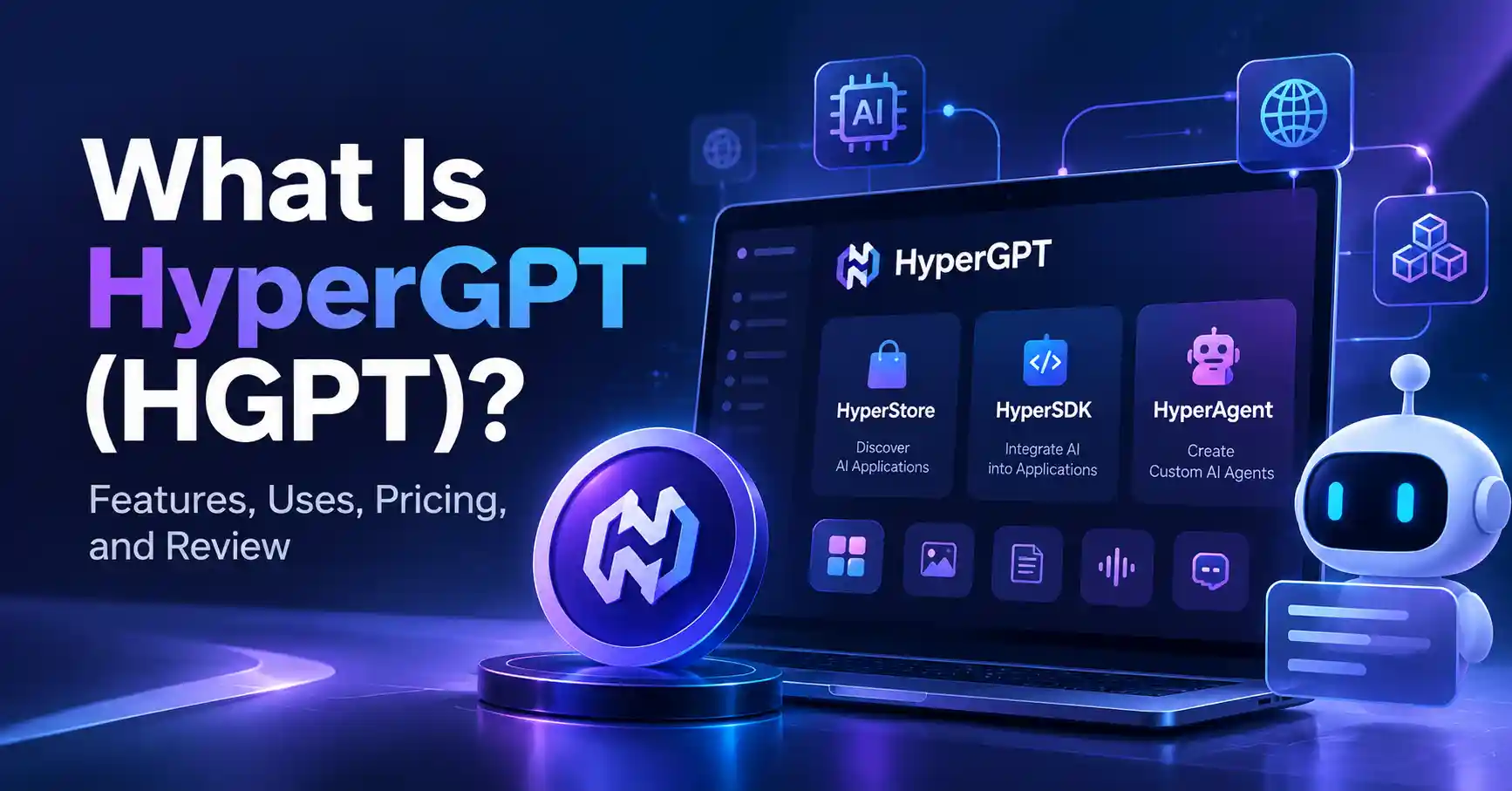
What Is HyperGPT (HGPT)? Features, Uses, Pricing, and Review
Published October 26, 2026
HyperGPT combines AI application discovery, developer tools, and AI agent capabilities within a Web3 ecosystem. Rather than functioning like a conventional AI chatbot, it gives users access to a marketplace of AI applications and tools for building AI powered solutions. Its ecosystem also includes the HGPT utility token.
For digital marketers, content creators, developers, and small business owners, the main question is whether HyperGPT offers something useful for their work or introduces unnecessary complexity. Understanding its features, pricing, alternatives, and token related risks can help you decide whether it's worth exploring.
This guide covers how HyperGPT works, what its products offer, and what to consider before using them.
What Is HyperGPT (HGPT)?
HyperGPT connects users with AI applications and developer focused services through a Web3 ecosystem. The platform aims to make AI tools easier to discover while helping developers integrate AI capabilities into their applications and workflows.
Although the names are closely related, HyperGPT and HGPT refer to different things:
HyperGPT: The broader AI platform and ecosystem.
HGPT: The associated utility token.
HyperStore: A marketplace for discovering AI applications.
HyperSDK: Developer tools for accessing AI capabilities.
HyperAgent: A product for creating and configuring AI agents.
You can explore the platform on the official HyperGPT website.
These distinctions matter. Using an AI application, developing an AI powered product, and purchasing a cryptocurrency token are separate activities. Don't assume you need HGPT for every use case check the requirements of the specific service you plan to use.
Key HyperGPT Features and Practical Uses
HyperGPT brings AI discovery, development, and agent creation together within one ecosystem. Which features matter most depends on what you're trying to accomplish.
1. HyperStore: Discover AI Applications
HyperStore is HyperGPT's AI application marketplace. It lets users explore AI powered applications in one place rather than searching for individual services across the web. Official documentation describes application discovery, pricing filters, and integration options for certain applications.
For example, a digital marketer could use the marketplace to find tools for content creation, visual design, or repetitive tasks. Before choosing an application, check its output quality, export options, privacy policy, and subscription requirements.
The convenience of having multiple tools in one marketplace is useful, but it doesn't automatically make those tools better or cheaper than standalone alternatives.
2. HyperSDK: Integrate AI Into Applications
HyperSDK is designed for developers who want to incorporate AI capabilities into applications through an API. HyperGPT's documentation describes a shared account and credit balance for accessing AI services, supporting Web2 and Web3 use cases.
Imagine building an online store and wanting to add an AI assistant that answers product questions or helps customers find relevant items. A developer could investigate whether HyperSDK supports the required functionality.
HyperSDK may be worth evaluating if you need a unified integration layer. Before using it in production, verify model availability, API limits, authentication requirements, response times, and total usage costs.
3. HyperAgent: Create Customized AI Agents
HyperAgent lets users create AI agents, configure their behavior and knowledge base, and connect agents with Telegram bots. Its documentation also describes prebuilt agents and options for managing public or private visibility.
A small business, for instance, could explore building an agent that answers common customer questions using approved product information. A content team might investigate an agent that follows a defined editorial brief.
These are potential applications, not guarantees of accuracy. Test agents with realistic questions, incorrect assumptions, and unusual scenarios before allowing them to interact with customers.
HyperGPT Pricing: Is It Free?
HyperGPT doesn't have one universal price covering every application in its ecosystem. Costs can vary depending on the individual app, API usage, subscriptions, and any token related requirements.
For example, the official Flash pricing page lists the following plans:
These prices apply to the Flash application, not to every HyperGPT service.
Before paying for a tool, check which features its free plan includes, whether usage limits apply, and whether API calls incur additional charges. Also confirm whether the application requires HGPT or accepts conventional payment methods, and review its renewal and cancellation terms.
Developers should estimate costs using their expected monthly API requests rather than relying on a starting price. Content creators should test whether a tool improves a recurring task before committing to an annual subscription.
What Is the HGPT Token Used For?
HGPT is the utility token associated with the HyperGPT ecosystem. According to its official token documentation, its intended uses include payments for AI marketplace services, access to certain premium features, governance, staking, and participation in rewards programs.
The exact requirements may vary by product. Check the latest documentation before assuming a particular service requires HGPT.
It's also important to separate platform usage from token investment. You can evaluate an AI application based on its usefulness without treating HGPT as an investment opportunity.
Cryptocurrency tokens can fluctuate significantly in value. Transaction fees, liquidity, smart contract risks, changing token utility, and regulatory considerations can also affect users. Staking rewards aren't guaranteed, and increased platform adoption doesn't necessarily translate into a higher token price.
HyperGPT Alternatives: Which Platform Fits Your Needs?
HyperGPT isn't a direct substitute for every AI assistant or developer platform. The right alternative depends on whether you want to discover applications, experiment with AI models, or automate business workflows.
Hugging Face provides a broad model and developer ecosystem, with details available in its inference pricing documentation. Poe publishes subscription options on its official pricing page.
Choose HyperGPT if its marketplace, agent capabilities, or Web3 features align with your requirements. Hugging Face is worth considering when model access and experimentation are central to your work, while Poe may be more suitable if you mainly want to compare conversational AI models.
For business automation, evaluate Relevance AI against your integration needs and workflow complexity. Compare current pricing and usage limits before committing. Since these platforms serve different purposes, a price only comparison won't tell you which one fits your needs.
HyperGPT Review: Strengths and Limitations
HyperGPT's value depends on how much of its ecosystem you plan to use.
Potential strengths
Multiple ways to use AI: Users can explore applications, while developers can investigate API access and agent creation.
Developer flexibility: HyperSDK is designed to provide a unified approach to accessing AI capabilities.
Custom workflows: HyperAgent gives teams an option to explore customized assistants rather than relying exclusively on general purpose chatbots.
Web3 functionality: The token based ecosystem may be relevant to users who need blockchain related features.
Limitations to consider
Learning curve: New users need to understand the differences between the marketplace, APIs, agents, and token.
Variable costs: Pricing may differ across applications and usage models.
Product verification: Model quality, reliability, data handling, and integrations need to be assessed rather than assumed from product descriptions.
Additional crypto risks: Wallet management and token transactions introduce considerations that ordinary AI subscriptions may not require.
This assessment is based on official product documentation and published pricing information, not independent performance testing.
FAQ’s
Is HyperGPT the same as ChatGPT?
No. ChatGPT is an AI assistant, whereas HyperGPT is an AI and Web3 ecosystem that includes an application marketplace, developer tools, and AI agent offerings. They serve different purposes.
Can I use HyperGPT for content creation?
Potentially. You can explore its marketplace for applications that support writing, research, or visual content workflows. Check each tool's capabilities, limitations, and pricing before relying on it professionally.
Does HyperGPT offer free AI tools?
Some applications offer free plans. The official Flash pricing page, for example, lists a free Basic plan. However, availability and usage limits vary by application, so don't assume every HyperGPT service is free.
Is HGPT a cryptocurrency investment?
HGPT is a utility token associated with the HyperGPT ecosystem. Buying or holding it is a separate financial decision from using the platform. Token prices and returns aren't guaranteed, so anyone considering a purchase should independently assess the risks.
Conclusion
HyperGPT is worth exploring if you want to discover AI applications, experiment with customized agents, or investigate API based AI development within a Web3 ecosystem.
For marketers and content creators, start by evaluating individual applications against your existing workflow. Developers should review the SDK documentation and test API access, model availability, and costs before building around the platform. If you only need a straightforward chatbot, a conventional AI assistant may be simpler.
Start with a specific problem, test the relevant product, and measure its value before committing money or integrating it into a critical workflow. Treat HGPT token research as a separate decision rather than a prerequisite for evaluating the platform.
To explore more options read its guide to the best AI tools in 2026