Best AI Tools in 2026: The Ultimate Guide to 15 AI Platforms That Are Actually Worth Using
Published August 5, 2026
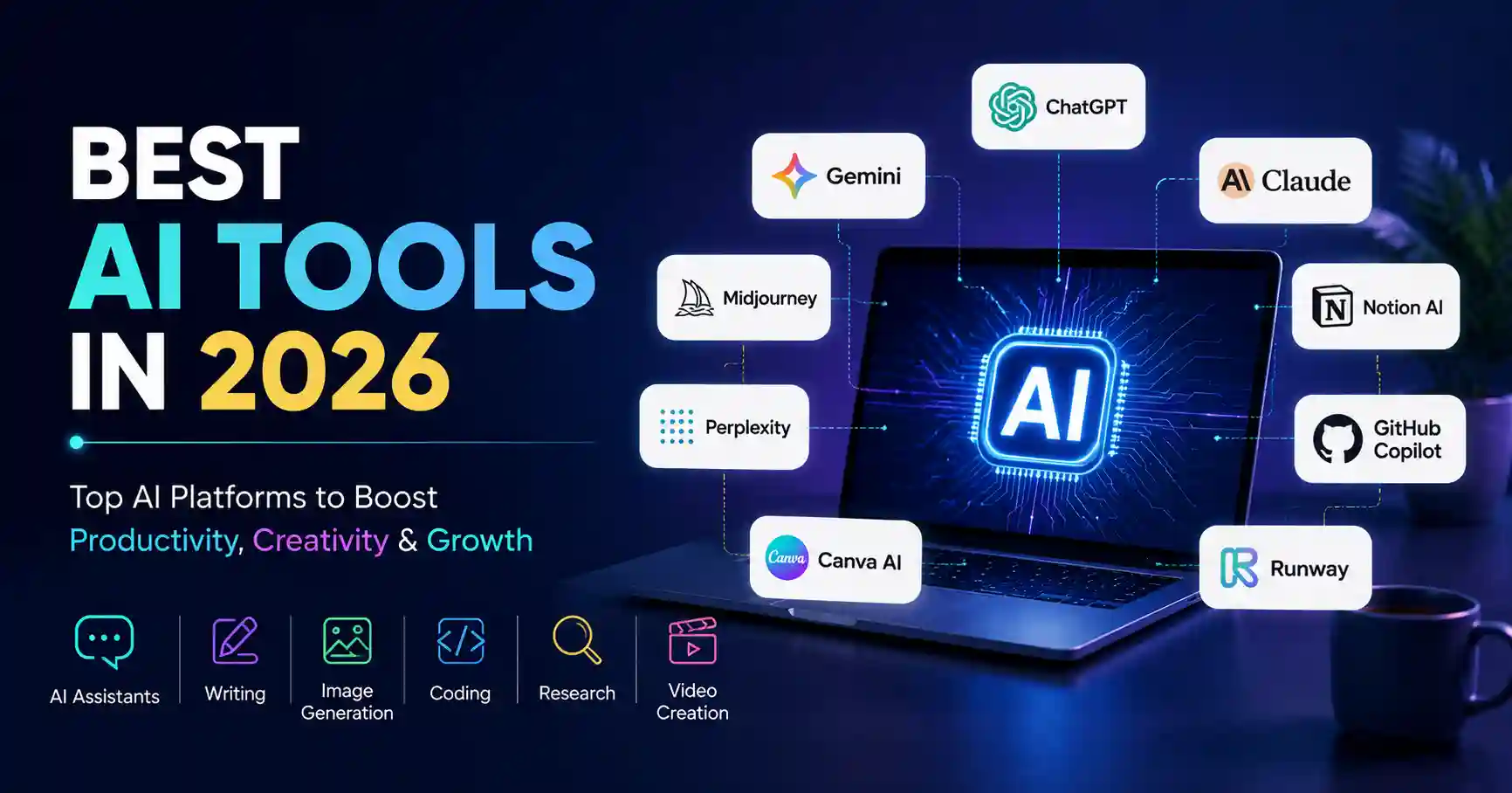
Have you ever opened Google , searched for the best AI tools, and then ended up staring at the same roster over and over on almost every website. You know, ChatGPT, Gemini, Claude, Midjourney… and then a couple of odd tools mixed in with tiny blurbs, or explanations that feel rushed. It can get overwhelming fast, mainly when fresh AI platforms appear every week, like clockwork.
Here’s the real deal, picking the right AI tool in 2026 isn’t about chasing the one with the most features. It’s more about finding the platforms that genuinely make your work easier, faster, smarter. Whether you’re a student, marketer, developer, entrepreneur, designer, or content creator, the right AI assistant can save you hours each week and help you produce results that are actually better.
To make this guide, we looked at top competitor write ups from sites such as Zapier, G2, TechRadar, Tom's Guide, and PCMag. Most of them keep bringing up popular AI tools, but quite a few kinda miss the everyday use cases that matter, like where they actually land in your workflow, and how pricing value plays out in real life. Also which tools are truly worth paying for in practice, not just because they are trending. This piece ties all those findings together in one place , so you can make a better decision based on your real needs, not only the hype.
Why Are the Best AI Tools More Important Than Ever in 2026?
Artificial intelligence has moved from this kind of far away futuristic idea into a real daily productivity buddy thing, it’s actually showing up in everyday work. Companies are automating repetitive chores , students are making research feel lighter somehow, developers are crafting cleaner code, and marketers are spinning up campaign plans faster than ever before.
The real change in 2026 isn’t that AI has somehow become more intelligent, it’s that AI has become more reachable. Even free versions of the top platforms today can do work that used to need costly software or very specific know-how.
As technology strategist Ethan Brooks says,
"The future belongs to professionals who know how to work alongside AI, not those trying to compete against it."
If you're just starting your AI journey, explore the AI Tools Directory to discover hundreds of AI platforms organized by category, making it easier to compare tools before choosing one.
Which Are the Best AI Tools You Should Try in 2026?
Not every AI platform is really built the same purpose. Some are better for writing, others dive into coding, image generation, or workflow automation, and that difference matters. Here are the best AI productivity tools and generative AI tools, worth taking a look at this year.
ChatGPT – Best Overall AI Assistant
ChatGPT keeps leading the AI scene because it’s incredibly versatile or something like that. Whether you’re writing articles, generating code, brainstorming ideas, dissecting documents, or picking up new concepts, it’s one of the most complete AI assistants you can find.
Key strengths include:
Excellent reasoning capabilities
Supports voice conversations
File uploads and document analysis
Image generation
Custom GPTs for specialized tasks
Fast and intuitive interface
For professionals juggling multiple responsibilities, ChatGPT often replaces several standalone applications.
Google Gemini – Best AI for Google Workspace
If your daily workflow revolves around Gmail Docs, Sheets, Drive, or Meet , Google Gemini integrates pretty natural into those tools.
Instead of switching between multiple apps, you can summarize emails, draft documents, analyze spreadsheets, and research information directly inside Google’s ecosystem.
Its deep integration makes it one of the most practical AI productivity tools for business users.
Claude – Best AI Writing Tool
Claude has become a favorite among writers, researchers, and analysts who put a lot of weight on high quality writing over flashy features.
Unlike a bunch of AI chatbots Claude tends to output longer, more structured, and more natural responses, which makes it ideal for:
Blog articles
Business reports
Research papers
Documentation
Content editing
If you're searching for professional AI writing tools, Claude deserves a place near the top of your shortlist.
Midjourney – Best AI Image Generator
Visual content stays one of the biggest strengths in generative AI, and Midjourney keeps putting out some of the most high-quality artwork you can find.
Designers often lean on this AI image generator for:
Marketing creatives
Product concepts
Book covers
Social media graphics
Brand illustrations
The realism and artistic quality still outperform many competing image generation platforms.
How Can AI Productivity Tools Save You Time Every Day?
One common misconception is that AI just replaces human creativity. In reality, the best AI tools handle repetitive chores, so you can put your attention on higher value work and keep that creative spark more intact .
Here are just a few examples:
Writers use AI to generate outlines before adding their expertise.
Developers automate repetitive coding tasks.
Marketing teams create campaign ideas in minutes instead of hours.
Designers generate multiple creative concepts instantly.
Students summarize lengthy research papers within seconds.
As AI consultant Rachel Morgan explains,
AI doesn't replace creativity, it helps creative people, keep more focus time to create.
If you are looking at different platforms before you subscribe, the Compare AI Tools page lets you check features next to each other, so you can pick the better solution for your workflow.
Which AI Search Engine Provides the Most Reliable Answers?
Traditional web search engines throw back a bunch of results, hundreds of pages maybe, and then people have to do the filtering themselves, like pick the right tab, and cross check, or read everything, sometimes it’s exhausting.
Modern AI search engines do things a bit different, they try to assist while you search, not just dump a list and walk away.
In the leading options, Perplexity AI really stands out, because it blends conversational AI with live web sources, so instead of just links you get direct answers, but you can still verify what you see via citations, which feels more reliable overall.
This makes it especially valuable for:
Researchers
Journalists
Students
Business analysts
Content marketers
Rather than just replacing Google Search, AI search engines do a complementary kind of job, reducing the research time while still keeping transparency there, too.
What Features Should the Best Generative AI Tools Offer?
The most successful generative AI tools in 2026 do way more than just produce text.
When picking an AI platform, pay attention to features like:
Natural conversations
Document analysis
Voice interaction
Image generation
Video creation
Workflow automation
API integrations
Team collaboration
Strong privacy controls
Real-time web access
This is the reason your AI assistant can keep evolving as your workflow matures, not becoming just another isolated application that stays in the background quietly, while you move on.
Are Free AI Tools Good Enough?
For a lot of users absolutely.
Most major platforms including ChatGPT, Gemini, Claude, Canva AI, and Perplexity provide those generous no-cost plans that work well for learning, trying things out, and yes even for real professional assignments.
However, premium subscriptions generally provide:
Faster responses
Access to advanced AI models
Larger file uploads
Better reasoning
Priority access during peak hours
If AI plays a major role in your daily work, upgrading often delivers a worthwhile return on investment.
For readers interested in learning more about Google's latest AI research and innovations, visit Google AI, one of the industry's most trusted resources.
Final Thoughts
Finding the best AI tools in 2026 isn’t about downloading every trending app you see online. It’s more about putting together an AI toolkit that actually fits your goals, your day to day workflow, and your budget, without rushing into everything at once.
Whether you’re making content, writing code, generating images, coordinating projects, or doing research, the current AI platforms can massively boost productivity and spark creativity, if you use them with some intention and not just curiosity.
Pick one or two solid tools, learn them deeply first ,then slowly grow your AI stack as your needs change. By the end you’ll feel less friction, you’ll move faster, and you may end up with a real advantage in a world that’s getting more AI powered each year.
Have you tested any of these AI tools yet? We’d genuinely like to hear your experience. Drop your favorite in the comments, or tell us about another AI platform you think should be included here.
FAQ’s
Which is the best AI tool in 2026?
ChatGPT still ends up being the most versatile AI assistant ,while Gemini, Claude, Midjourney and Perplexity AI take the lead in their own areas, for their respective categories, pretty much.
What are the best free AI tools?
ChatGPT, Google Gemini, Claude, Canva AI, and Perplexity AI all offer capable free plans for beginners and for professionals too , you know.
Which AI writing tool is best for long-form content?
Claude gets a lot of recognition for making natural, well structured long form writing , and then there is ChatGPT that shines on versatility and editing sometimes.
Which AI image generator creates the best visuals?
Midjourney still manages to be one of the better AI image generators for realistic artwork, illustrations and creative designs, even if folks keep comparing it with other tools, sometimes too much.
Are AI productivity tools worth paying for?
If you use AI daily for work, a premium subscription can really save a lot of time. It may deliver better models , quicker replies, and more advanced capabilities without the hassle.