Artificial Intelligence Latest Developments in 2026: Key Trends and Breakthroughs
Published October 28, 2026
Artificial intelligence is moving beyond chatbots that simply answer questions. In 2026, much of the progress is focused on systems that can handle multi step tasks, assist with software development, work across business applications, and support scientific research. Developers are also working to make these systems more efficient, easier to control, and more useful in everyday settings.
For marketers, developers, content creators, and business owners, finding an AI tool is only the first step. The real challenge is figuring out which capabilities solve a genuine problem and which still require careful testing.
This guide examines the latest developments in AI, their potential impact on everyday work, and what to consider before adopting new technology. It draws on official product announcements available as of October 28, 2026.
What Are the Latest Developments in Artificial Intelligence?
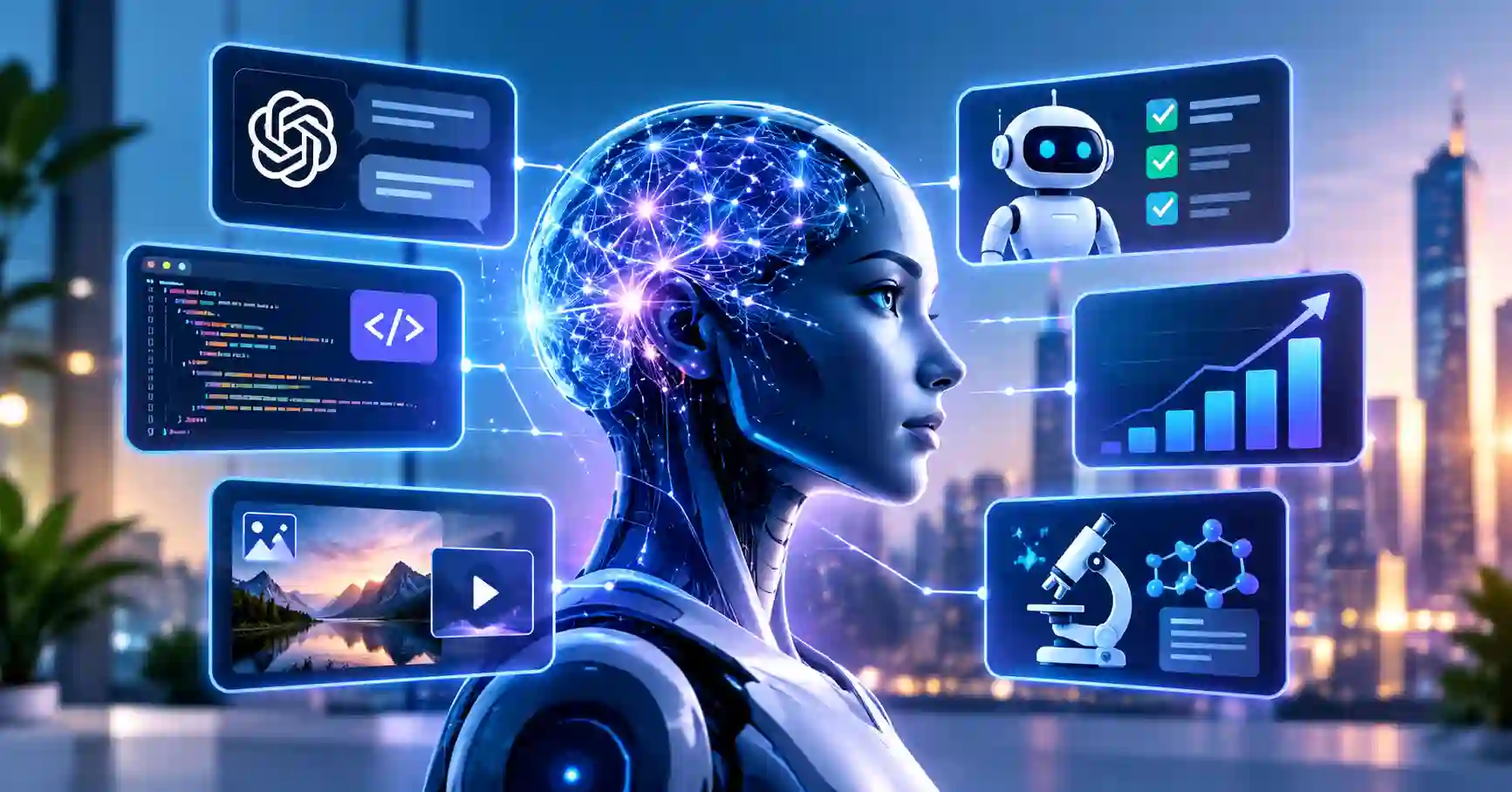
Five areas stand out: more capable AI models, autonomous AI agents, AI assisted coding, generative media, and AI applications in business and research.
Recent announcements illustrate this shift. OpenAI introduced GPT 6.1 Terra on October 26, Anthropic announced Claude Haiku 5.5 on October 7, and Google Cloud introduced its Gemini agent for workplace tasks on October 8. Together, these announcements reflect growing interest in reasoning, computer use, coding, and workflow automation.
The important question isn't simply which company has released the newest model. It's how these developments can help people work more effectively.
1. More Capable AI Models and Reasoning
AI models are increasingly designed to handle complex instructions, tackle larger tasks, and support specialized work. Rather than responding to a single prompt, newer systems aim to help users work through problems that involve several steps.
Consider a marketing professional researching competitors. An AI assistant could organize the research, identify recurring themes, draft a content brief, and prepare an outline for review. The marketer would still need to verify the sources and decide which recommendations make sense for the business.
OpenAI's product announcements and Anthropic's model newsroom provide information about their latest releases and stated use cases.
Who benefits most? Researchers, analysts, developers, and professionals handling complex knowledge work.
What to consider: Better reasoning doesn't guarantee accurate answers. Test models on tasks that reflect your actual work, verify important claims, and consider how much editing each output requires.
2. AI Agents and Autonomous Workflows
One of the most important artificial intelligence trends in 2026 is the shift from conversational assistants to AI agents.
A chatbot generally responds to questions. An AI agent can be designed to plan a sequence of actions, use connected tools, and work toward a specific outcome. Depending on its setup and permissions, it might gather information, update a document, run code, or coordinate several steps in a workflow.
How businesses can use AI agents
Google Cloud's October 2026 announcement describes a Gemini agent designed to handle knowledge work, create content, write and run code, and work with connected business applications. Google also describes controls for managing permissions, agent activity, and enterprise security. These are vendor reported capabilities, and actual access depends on the product and deployment.
Imagine a small e commerce business preparing to launch a new product. An agent assisted workflow could organize product information, draft promotional content, summarize customer feedback, and prepare a campaign checklist.
The business owner would still need to approve pricing, marketing claims, customer facing messages, and decisions with financial consequences.
Best suited to: Teams handling repetitive, well defined processes across multiple applications.
Main limitation: Errors can compound when an agent makes several decisions in sequence. Poorly configured permissions or vague instructions can also create security and operational risks. Start with low risk tasks and require human approval for consequential actions.
3. AI Coding and Software Development
AI coding tools are moving beyond basic code suggestions. Newer models and development workflows increasingly focus on debugging, code analysis, repository level tasks, and multi step software engineering.
Anthropic's September 2026 announcement for Claude Opus 5.5 highlights agentic coding and knowledge work. Its October release of Claude Haiku 5.5 focuses on high volume tasks, including summarization, subagents, and browser use. These descriptions reflect the company's stated product priorities, not independent proof that either model is the best choice for every development task.
For a developer building a website, an AI coding assistant could help explain an error, generate a test, or suggest changes across related files. The developer must still check that the code works, doesn't introduce vulnerabilities, and doesn't break existing functionality.
When comparing tools, consider:
Compatibility with your editor and development environment.
How well the tool works with your codebase and tests.
The usefulness of its explanations and debugging suggestions.
Data handling policies and access permissions.
Total cost and the time required to review generated code.
Who should explore this trend? Developers, software teams, technical founders, and businesses maintaining internal applications.
AI can simplify parts of software development, but generated code shouldn't be considered secure or production ready without appropriate testing and review.
4. Generative AI for Images, Video, and Audio
Generative AI is making it easier to create and edit visual and audio content. For marketers and content creators, its practical value lies in developing initial drafts, exploring creative concepts, adapting existing assets, and reducing repetitive production work.
For example, a marketing team could generate several campaign concepts, explore different visual directions, and prepare draft assets for different channels. A designer could then refine the strongest options to match the brand's guidelines.
The right tool depends on the intended output.
Not every tool offers the same output quality, commercial usage rights, or free plan allowances. Check official product terms before using generated assets in client projects or paid campaigns.
5. AI in Business, Productivity, and Scientific Research
AI is becoming more closely integrated with existing business systems. Rather than switching between separate applications, users increasingly want assistance within the tools they already use to manage documents, communications, data, and projects.
Google Cloud's Gemini at Work announcement describes integration across Google Workspace applications, including workflows involving data analysis, coding, and business tasks. It also discusses security and governance features for enterprise use.
Scientific research is another area worth watching. OpenAI's October 2026 research updates include work involving AI agents and biological data. These developments illustrate how researchers are exploring AI to investigate complex problems. They should be understood as research progress, not proof that AI has independently solved every challenge in a scientific field.
For smaller businesses, the best starting point may be much simpler: summarizing documents, organizing research, preparing reports, or drafting customer support responses.
Identify a specific bottleneck first, then measure whether AI improves the overall process.
How to Choose the Right AI Tools in 2026
The newest AI technology isn't necessarily the right choice for your business. Before paying for a subscription or connecting an agent to your systems, test tools against a real task.
Explore the Allaipedia AI tools directory to find products by category. If you're evaluating software for your business, read how to choose the right AI tool for your business for a more structured approach.
Shortlist two or three alternatives and test them on the same task. Compare accuracy, usability, integration requirements, total cost, and the effort needed to correct their output. Check official pricing pages for current features and plan limits, as prices and availability can change.
Limitations and Risks to Consider
Despite the progress, AI systems still have several limitations.
Accuracy: AI can produce convincing but incorrect information. Verify factual claims, calculations, and technical recommendations.
Privacy: Review data retention policies, access controls, and terms before uploading confidential documents or customer information.
Security: Agents that access files, run code, or interact with applications need carefully scoped permissions.
Cost: Subscriptions, usage based charges, implementation, and human review can make a seemingly inexpensive tool costly in practice.
Copyright and accountability: Check licensing terms and applicable rules before publishing generated media or using AI in consequential decisions.
For business adoption, begin with a low risk workflow, define what success looks like, and assign responsibility for reviewing important outputs.
FAQ’s
What are the biggest AI trends in 2026?
Major areas include AI agents, more capable reasoning models, AI assisted software development, generative media, and integration with business workflows. Their practical value depends on the task, implementation, and reliability requirements.
How are AI agents different from chatbots?
A chatbot primarily responds to prompts, while an AI agent can plan and execute multiple steps using connected tools, depending on its design and permissions. Agents need closer oversight when they can modify files, access business systems, or take consequential actions.
Are the latest AI tools free to use?
Some tools offer free access or limited trials, while advanced features may require paid plans or usage based billing. Check the official pricing page for the relevant product, region, and plan before committing.
How can a small business benefit from new AI technology?
Start with a repetitive, measurable task, such as drafting product descriptions, summarizing documents, preparing reports, or organizing customer enquiries. Test a suitable tool on a small scale, account for review time and subscription costs, and expand only if the results justify it.
Conclusion
The most important artificial intelligence latest developments in 2026 aren't just about more powerful models. They're about making AI more useful in everyday work through agents, coding assistance, generative media, and connected business workflows.
Rather than chasing every new release, focus on a problem worth solving. Choose tools that fit your workflow, verify their capabilities, protect sensitive information, and measure the results before expanding their use.
AI can make work more efficient, but sound judgment, reliable processes, and human oversight remain essential.