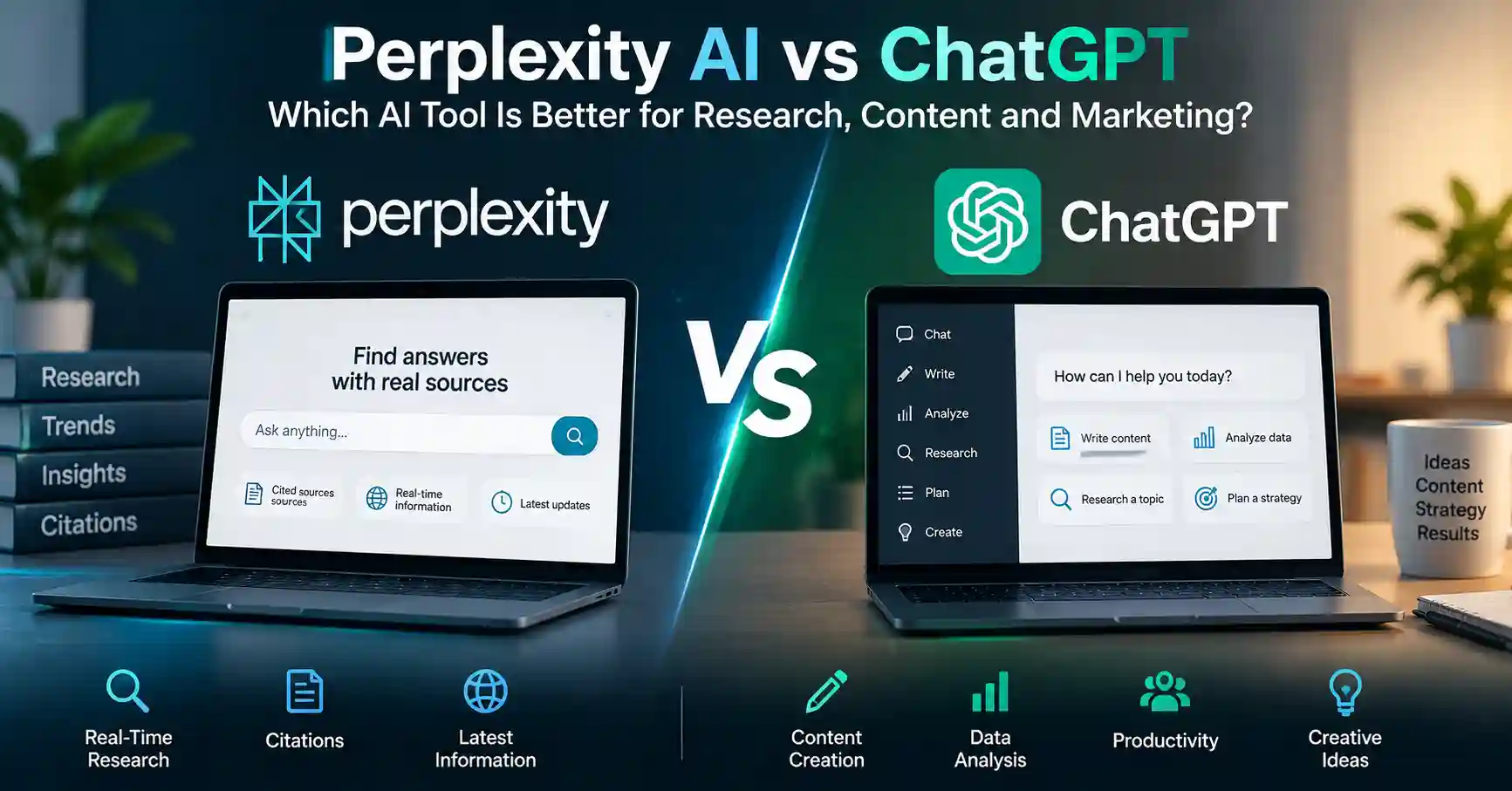
Perplexity AI vs ChatGPT: Which AI Tool Is Better for Research, Content and Marketing?
Published September 4, 2026
Introduction
People often ask how Perplexity AI compares to ChatGPT. It can matter for marketers, researchers, content teams, and other business users who need help day to day. Both tools can respond to questions, dig into a topic, pull out key points, and support content work. Still, they do it in different ways.
Perplexity leans hard toward web based searching. It tends to give answers with sources you can check. ChatGPT mixes research with drafting and thinking. It can also help with planning, analysis, and other work tasks beyond just finding facts.
In the rest of this guide, you will see what sets them apart. You will also learn when each one fits best. Finally, you will get ideas for using both tools together.
Table of Contents
What is Perplexity AI vs ChatGPT
Why Perplexity AI vs ChatGPT is Important
Step by Step Guide
Best Practices and Tips
Common Mistakes
Tools
FAQs
Conclusion
What is Perplexity AI vs ChatGPT
Perplexity and ChatGPT both help people with AI tasks. Still, they are built for different kinds of work.
Perplexity feels more like a search and answer tool. It looks through online material, pulls together key points, and gives citations so you can review where the details came from.
ChatGPT is more like a general work area for AI. It can handle many tasks at once, such as answering questions, writing and editing text, breaking down information, and working with files. It can also search the web. With ChatGPT Search you get fresh web results with links. With Deep Research you can run a longer chain of steps and end up with a cited write up.
Say a marketer wants to learn what changed in SEO lately. They might use Perplexity to find recent posts and reliable references fast. Then they could switch to ChatGPT to shape that material into a content brief, a competitor scan, an outline for an article, or a campaign plan.
Why Perplexity AI vs ChatGPT is Important
Choosing the right AI tool can affect research quality, productivity, and the amount of manual verification required.
Perplexity shines when you are hunting sources and need strict citations.
ChatGPT steps in once raw research must become sharp prose, deep strategy, or polished deliverables.
And yet, both platforms pull fresh web data instantly.
Perplexity supports multiple AI models in some paid workflows, allowing users to select or automatically route queries to different models.
ChatGPT Deep Research can combine web research, reasoning, uploaded files, and selected websites into a documented report.
Digital marketers face a real question, it is never about which platform rules overall. Instead? You have to figure out which tool fits your specific workflow stage.
Step by Step Guide
Step 1: Define the task before choosing the tool
Figure out what you need first.
What are you trying to do?
If you want fresh facts, finding sources, competitor details, or fast market research, Perplexity can help.
If you want research plus interpretation, writing drafts, making sense of data, or advice for a plan, ChatGPT may fit better.
Instead of asking which tool is best, spell out the work.
For instance: look at five competitors, note where their content is weak, then build a content plan.
Step 2: Use Perplexity for fast source discovery
Start with a focused question in Perplexity. Its answer engine searches the web and presents cited information, making it useful for discovering sources quickly.
For example, a marketer could ask:
What are the most important technical SEO trends affecting ecommerce websites in 2026?
The goal at this stage is not to publish the answer. It is to identify useful sources, trends, statistics, and competing viewpoints.
You can also explore additional AI resources through the AI tools directory.
Step 3: Use ChatGPT for deeper analysis
Once you have gathered useful information, move into analysis. ChatGPT can use search and Deep Research to investigate complex questions, compare sources, and create structured findings.
For example, give ChatGPT the research question:
Look at those trends closely, then isolate what truly matters for SaaS companies chasing organic traffic. That shift from raw metrics to brutal, decisive choices is everything.
Step 4: Compare the platforms by workflow
The biggest differences become clearer when you compare how each tool fits into professional work.
Takeaway: Perplexity is often strongest for source driven research, while ChatGPT is often stronger when research needs to become analysis, content, or a finished deliverable
Step 5: Build a combined workflow
You do not have to choose only one.
A practical workflow is:
Use Perplexity to discover current sources and competing perspectives.
Open and verify the most important sources.
Bring the research into ChatGPT for analysis.
Ask ChatGPT to create the final brief, article, report, or strategy.
Verify important claims against the original sources before publishing.
This method cuts down on the urge to treat an AI reply as the last word. OpenAI also tells people to verify key details and go back to the sources that were cited.
Best Practices and Tips
Set the goal first. Say what choice you need to make, or what you must deliver. Then pick the right method to get there.
Precise prompts matter. Define audience, timeline, market, rivals, and concrete deliverables right now.
Always demand evidence for rules, claims, statistics, and trends.
Verify important information using the original source. Citations improve transparency but do not guarantee that every statement is correct.
Separate research from creation. First establish reliable information, then create content from the verified findings.
Challenge that initial reply. Find the missing facts, outdated assumptions, hidden biases, and total lack of proof. Dig deeper.
Keep a repeatable workflow. For marketing teams, standard prompts can make research and content production more consistent.
Perplexity suggests using targeted searches and uploading files when it makes sense. Its Research tools can then run repeated searches and combine details from different sources.
Common Mistakes
Assuming the tool with more citations is automatically more accurate. Sources still need to be checked.
Using AI research without defining a timeframe. Current marketing information can change quickly.
Asking one broad prompt for an entire marketing project instead of breaking it into research, analysis, and execution.
Copying AI generated content directly into a website without fact checking, editing, or adding original expertise.
Choosing a platform based only on popularity instead of evaluating the specific workflow and output required.
Tools
Perplexity is useful for web research, source discovery, current information, and research reports. Its Research mode can conduct multiple searches and synthesize findings into a report.
ChatGPT is useful for research, writing, reasoning, data analysis, content development, and strategic workflows. Its Deep Research feature can produce cited reports using information from the web and other permitted sources.
Marketers scour the directory to unearth fresh platforms covering research, writing, SEO, design, productivity, automation, and more. Truly.
FAQ’s
Is Perplexity better than ChatGPT for research?
It depends on the type of research. Perplexity is particularly convenient for web first research and source discovery because citations are central to its answer experienceChatGPT works well when a task needs more than just answers. It is useful if you must combine research with reasoning. It also helps when you have to analyze uploaded material. It can even help you turn the work into a clear final output.
Is ChatGPT better than Perplexity for content writing?
ChatGPT often fits better for content work. It can start with research and analysis, then keep going through writing, revising, reshaping, and polishing the text.
Perplexity can also support writing tasks. This is most useful when you need up to date information from the web.
Which is better for SEO research?
Perplexity helps you spot what people are searching for right now. It can also pull up details about rivals and ongoing talk in the field. It may even point you to sources you can cite.
After that, ChatGPT can take what you found and group related terms. It can draft a content plan. It can also build an outline and a list of questions for an FAQ. Then it can suggest next steps.
Can I use Perplexity and ChatGPT together?
Actually, combining them works best. Perplexity digs up reliable sources and handles tough web research. Then ChatGPT chews those raw findings into polished, practical business outputs. Why choose?
Should marketers trust AI generated information?
Don't treat any AI as an absolute authority. Always check stats, quotes, and critical business calls against the original sources, Sure, tools like ChatGPT and Perplexity give you shortcuts to verify stuff now. But humans still need to do the final fact check.
Conclusion
The Perplexity AI versus ChatGPT debate isn't about crowning some ultimate champion, it is about picking the right tool for the exact job on your desk. Period. Perplexity shines when you need quick web research, fresh facts, and clear source links right out of the box. Meanwhile, ChatGPT steps up when you want to mix that research with deeper reasoning, drafting, crunching numbers, and actual final deliverables.
For digital marketers, the smart play might just be using both. Kick things off with Perplexity to catch what is happening right now and trace where the facts live. Then switch over to ChatGPT when you need to figure out what those facts actually mean and build an actionable strategy from them.
Keep it simple. Take one manual marketing chore you do every week, and test both platforms on that exact brief. Compare the sources, the analysis, and what you get at the end.