Claude vs Gemini: Which AI Is Better for Content, Coding, Research, and Business
Published September 4, 2026
Introduction
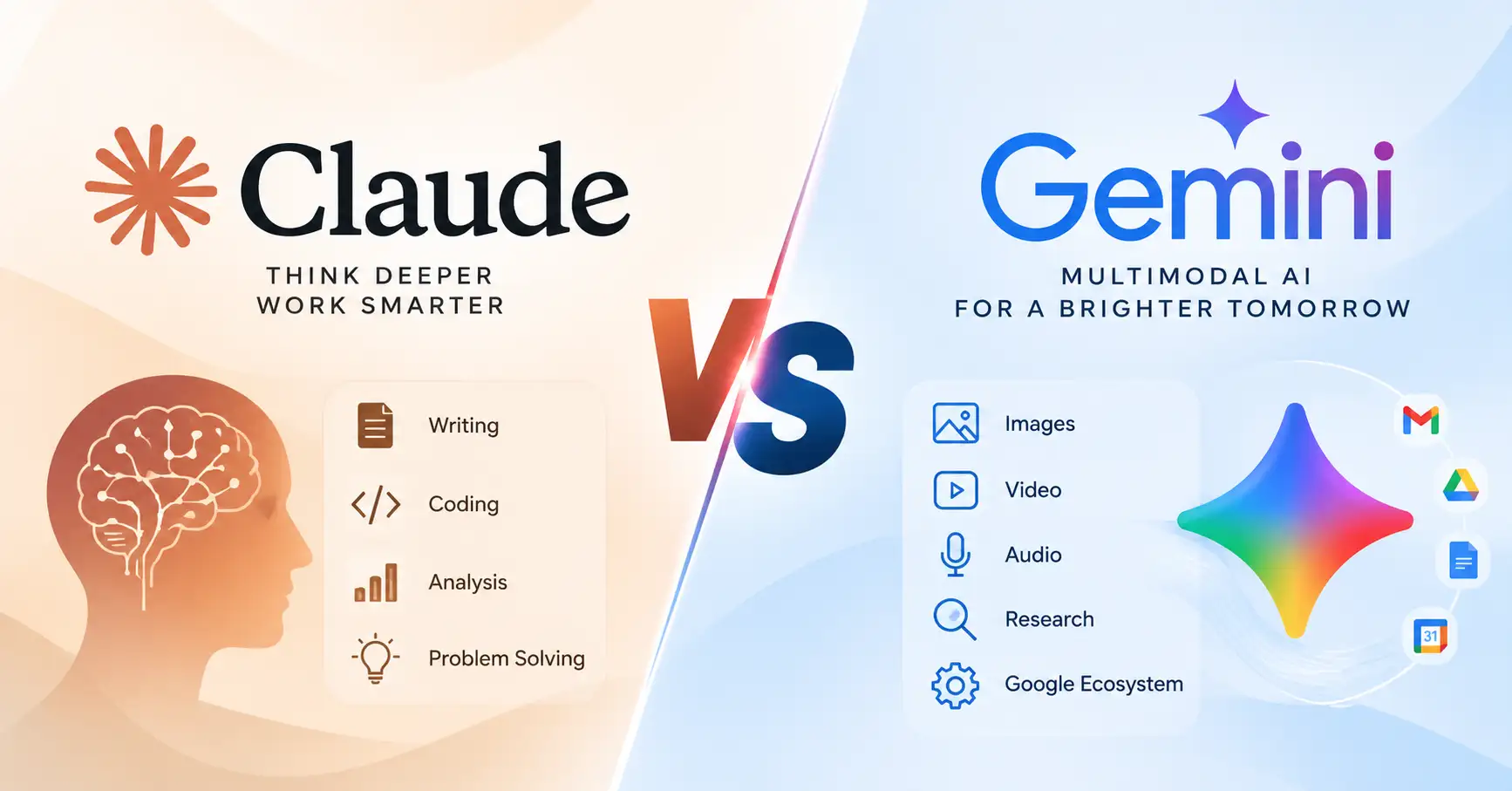
Choosing between Claude and Gemini goes beyond merely selecting the chatbot offering the cleverest responses today. Both evolved into massive AI systems. They handle research, write code, run deep analysis, automate tasks, and fit right into professional workflows. Claude excels at structured logic, heavy coding, long writing jobs, and sticking rigidly to strict prompts. Gemini takes the lead whenever you throw multimodal tasks at it or lean heavily on the Google ecosystem.
Forget the benchmarks. It comes down to your daily grind. This guide pits Claude against Gemini across real world jobs so you can figure out which one actually fits your desk.
Table of Contents
What is Claude vs Gemini
Why Claude vs Gemini is Important
Claude vs Gemini Comparison
Step by Step Guide
Step 1 Identify Your Main Use Case
Step 2 Test Both Models With the Same Prompt
Step 3 Compare Output Quality
Step 4 Test Your Real Workflow
Step 5 Choose Based on Business Value
Best Practices and Tips
Common Mistakes
Tools
FAQs
Conclusion
What is Claude vs Gemini
Claude is the family of AI models developed by Anthropic. Its current model lineup includes models designed for different levels of reasoning, coding, professional work, and agentic tasks. Anthropic describes its latest Claude models as capable of handling long running coding and knowledge work, with some models offering very large context windows.
Gemini is Google's family of AI models and products. Gemini is designed for text, images, video, audio, coding, reasoning, and agentic workflows. Google also connects Gemini with products and development platforms such as Google AI Studio and its wider AI ecosystem.
For example, imagine you give both tools a 20 page marketing research report and ask for an executive summary, competitive insights, and five content ideas. Claude may be particularly attractive when you care about careful writing and instruction following. Gemini may be more attractive when the workflow also involves images, video, audio, or Google based tools.
Why Claude vs Gemini is Important
Picking one of these platforms is not just a tech choice. It comes down to how you work each day. The best AI option is often the one that matches your workflow. Not the one that looks best on a chart.
• Better productivity: The right model can reduce repetitive research, writing, analysis, and coding work.
• Better output quality: Different models have different strengths in reasoning, writing style, coding, and multimodal tasks.
• Better workflow integration: Gemini can be useful when your work already depends heavily on Google's AI and productivity ecosystem.
• Better project fit: Claude has become increasingly focused on professional knowledge work, coding, and autonomous agentic tasks.
• Lower switching costs: Testing both before committing can reveal which model performs better on your actual work.
Claude vs Gemini Comparison
Column headers: Category, Claude, Gemini, Best Fit
The key takeaway is that Claude is often the better choice for focused writing, coding, and knowledge work, while Gemini becomes especially compelling when multimodal capabilities and Google's ecosystem are central to the workflow.
For the latest Claude capabilities, Anthropic describes its newest models as improving coding, tool use, professional work, and long running tasks. Google similarly highlights Gemini capabilities across agentic coding, multimodal understanding, long horizon tasks, and multi step problem solving
Step by Step Guide
Step 1 Identify Your Main Use Case
Start with the task you perform most often.
If you are a content strategist, test blog research, content briefs, editing, and competitive analysis. If you are a developer, test code generation, debugging, refactoring, and documentation.
Do not choose a model based only on general chatbot conversations.
Step 2 Test Both Models With the Same Prompt
Create three to five realistic prompts from your daily workflow.
For example, give both models the same product page and ask them to create a search focused content brief targeting a specific audience. Keep the prompt, source material, and requirements identical.
This creates a more useful comparison than reading isolated benchmark results.
Step 3 Compare Output Quality
Look beyond whether the answer sounds good.
Check factual accuracy, instruction following, structure, originality, unnecessary repetition, citation quality, reasoning, and the amount of editing required.
For content teams, calculate how much human editing each output needs. A slightly slower model that produces publishable work can be more valuable than a faster model requiring extensive rewriting.
Step 4 Test Your Real Workflow
Move beyond individual prompts.
Ask each platform to complete a small end to end workflow. For example, research a topic, organize the findings, create an outline, draft the article, identify gaps, and produce a final optimization checklist.
This is where differences between Claude and Gemini can become much clearer.
You can also explore other AI tools through the AI tools directory at All AI Pedia to identify specialized tools for research, content, automation, and productivity.
Step 5 Choose Based on Business Value
Do not choose simply because one model produced a better answer once.
Track real impact. Then weigh hours reclaimed, editing velocity, pinpoint accuracy, frictionless workflows, and dollars spent.
Say a tool cuts a four hour workflow down to two hours. Another tool cuts it to two and a half hours. If you are picking what works day to day, the first one might be the safer pick. This is true even when the second one does better on a different kind of job.
Best Practices and Tips
• Build a small test set of real tasks before choosing a platform.
• Use the same instructions when comparing models.
• Test difficult tasks rather than only simple questions.
• Evaluate the amount of human editing required.
• Separate model quality from product and ecosystem advantages.
• Re test important workflows after major model updates.
• Keep sensitive business information out of AI tools unless your organization's privacy and security requirements are satisfied.
For developers, it is also worth checking the official Anthropic Claude documentation before selecting a model for production use because model availability and API capabilities can change over time.
For Gemini development workflows, Google's Gemini model and platform information provides the current view of available models and development options.
Common Mistakes
• Choosing based entirely on benchmark scores instead of real workflows.
• Comparing different model tiers without checking their capabilities.
• Assuming one model is automatically better for every task.
• Ignoring integration with existing software and business processes.
• Testing only easy prompts that do not reveal meaningful differences.
Tools
Claude can be useful for writing, coding, analysis, and complex knowledge work.
Gemini is handy for work that mixes text, images, and other formats. It can also help with study tasks and with writing code. It fits well when your projects are tied to Google’s AI tools.
Google AI Studio is a good pick if you are a developer and you want to test Gemini models. You can use it to try ideas fast and put together AI apps.
Claude Code is useful for developers who want to work with Claude as a coding agent inside development workflows. Anthropic has positioned its Claude models strongly around coding and agentic development.
For discovering additional AI software by category, the All AI Pedia tools directory can be useful when Claude or Gemini is not the best fit for a specific task.
FAQ’s
Is Claude better than Gemini
There is no universal winner. Claude can be a strong choice for long form writing, coding, reasoning, and professional knowledge work, while Gemini can be especially useful for multimodal tasks and workflows connected to Google's ecosystem.
Is Gemini better for research
Frankly, Gemini works well enough for digging into mixed media. But remember: your results ultimately hinge on the prompt, the specific model, and whether you actually check the sources.
Which is better for coding, Claude or Gemini
Both are capable coding platforms. Claude has a strong focus on software engineering and agentic coding, while Gemini also offers advanced coding and development capabilities. Pick the option that fits what you use day to day. Think about your programming language, your dev setup, the tools you rely on, and what kind of code you write most often.
Which is better for content writing
Claude is often a strong choice when the priority is structured, detailed, natural sounding writing and consistent instruction following. Gemini can also produce strong content, particularly when the workflow includes broader multimodal inputs.
Should businesses use Claude or Gemini
Businesses should evaluate both against their actual workflows.Before you decide, look at security needs, how it will plug into your systems, how well the model performs, and what admin settings are available. Also check the API options you can use, and think about the full cost to run it.
Conclusion
Forget treating Claude versus Gemini like some generic chatbot showdown because it actually comes down to how your daily workflows operate. Claude shines whenever you throw heavy coding, deep professional thinking, sprawling prose, or messy agentic setups at it. Gemini pulls ahead if you need serious multimodal muscle or lean heavily into Google ecosystem tools.
Finding the right fit is straightforward. Grab three messy tasks from your daily grind, feed identical prompts to both tools, and watch what happens. Track raw accuracy, cleanup time, latency, ecosystem hookups, and practical value. Whichever model delivers stronger output while demanding less babysitting simply wins the desk.