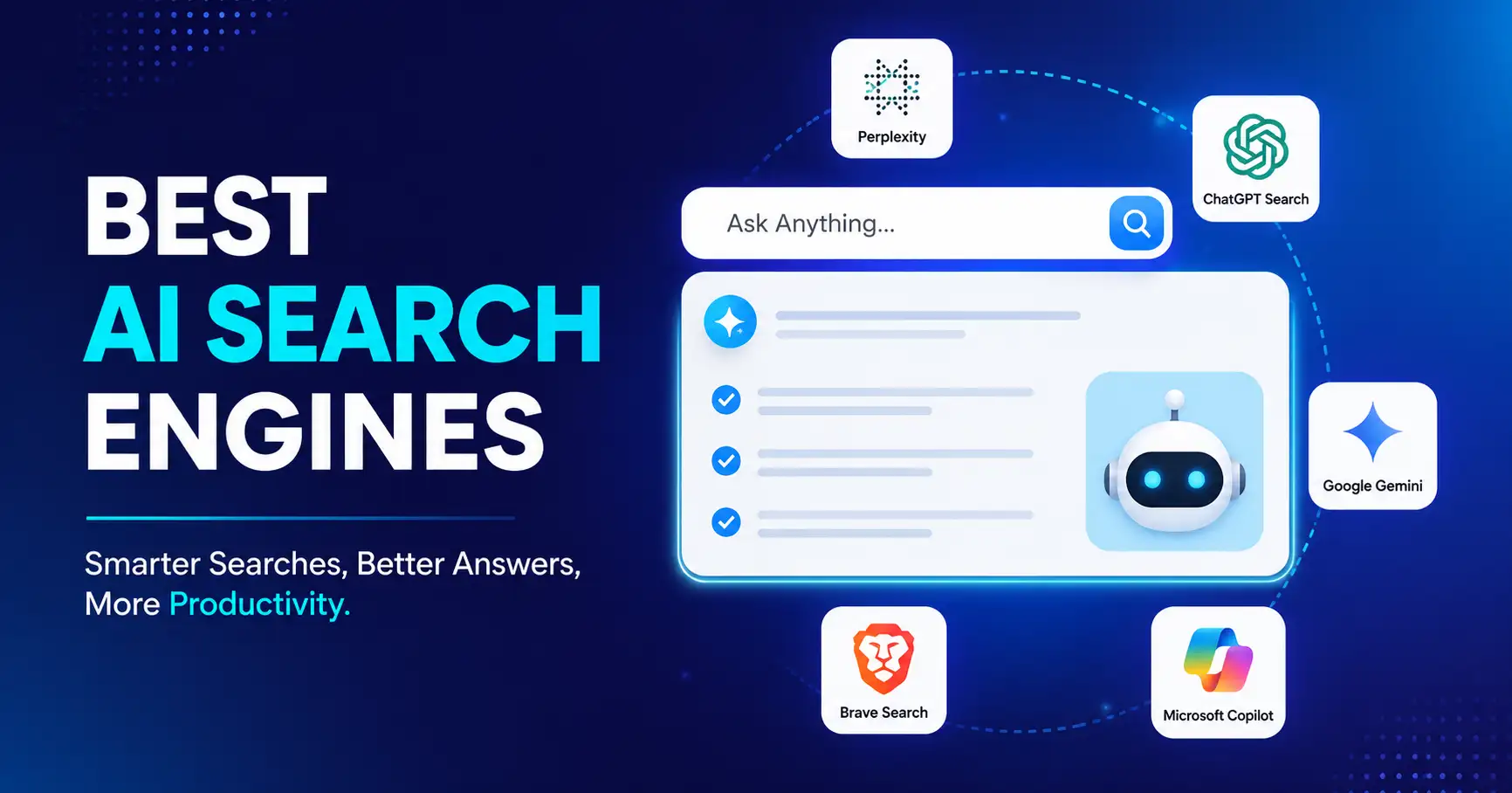
Best AI Search Engines: Top Tools for Faster and Smarter Research
Published August 24, 2026
Browsing the web is no longer just typing keywords into a box and clicking a dozen links. AI search engines actually grasp your true intent, sweep the entire internet, condense the facts, and hand you synthesized answers backed by clear citations. Handy for deep research, planning content, sizing up competitors, market studies, and random daily curiosities. Why do they matter? This guide breaks down what these intelligent systems are, how to master them, and which exact tools are actually worth a look.
Table of Contents
What is AI Search Engines
Why AI Search Engines is Important
Step by Step Guide
Best Practices and Tips
Common Mistakes
Tools
Comparison of AI Search Engines
FAQs
Conclusion
What is AI Search Engines
AI search engines mix standard web crawling with smart algorithms to grasp what you are actually asking. Instead of dumping a giant stack of blue links on your screen, they read everything and write out a summary.
Say you need the top email marketing strategies for SaaS companies. You could just type that exact thought right in. The engine sifts through relevant articles, pulls the pieces together, and hands you a neat response with all the sources attached.
You actually get citations, that matters. Platforms like Perplexity use this exact model, acting as conversational answer machines that anchor their replies in real web sources you can click and check yourself.
Why AI Search Engines is Important
AI search tools genuinely help marketers, business folks, researchers, and content creators. They save time. Why? Because they rapidly slash hours spent gathering and sorting valuable information.
They are important because they can:
Harvest infinite sources. Trim your research hours instantly.
Help users explore complex questions using natural language
Make competitor and market research faster
Include source links to easily verify facts.
Marketers unearth trends, topics, queries, and buyer needs. Imagine a content strategist, deep into AI marketing tools, Gone are the endless product page scans. They just ask an intelligent search engine. It'll instantly size up rival platforms, lay out real world uses, and pinpoint key differences.
Step by Step Guide
Step 1: Define What You Want to Find
Start with a clear goal. Vague queries give you junk.
Don't just type AI marketing into the box, Ask which AI marketing tools actually help SaaS content teams in 2026 instead.
That second approach hands the search engine real context. The results get sharp, and you can actually use them right away.
Step 2: Ask a Specific Question
AI search thrives on clear tasks. Say a marketer wants to know which channels actually drive B2B SaaS growth right now, with fresh examples. They just ask. You can dictate the exact format too. Want a comparison table? A quick summary? Recommendations or a plain explanation? Spell it out.
Step 3: Check the Sources
Never trust an AI blindly. Open primary sources. Always verify stats, pricing, specs, and bold claims yourself, this matters most during serious research. Even Perplexity urges users to check original links. Those handy citations exist to help you confirm facts, not to rescue you from actually reading the source text.
Step 4: Ask Follow Up Questions
AI search lets you keep pulling on the same thread instead of starting from scratch every single time. Picture this. You find a bunch of competitors, and then you immediately ask who has the best content strategy, what keywords they chase, and where the blind spots are. It builds an actual workflow, One search flows right into the next.
Step 5: Turn the Research Into Action
Now apply the information. Take your research and turn it into a content brief, competitor analysis, campaign idea, customer insight, or a business decision. A marketer might use AI search to spot common customer headaches, then build an entire blog plan out of those exact findings.
Best Practices and Tips
Detailed prompts always win over brief keyword strings for intricate subjects. Test it.
Always: current data on market shifts, pricing, and emerging trends. No, really.
Check primary sources before publishing important claims.
Compare answers from more than one AI search platform for high value research.
Separate facts from AI generated recommendations.
Ask the tool to identify disagreements between sources.
Save useful sources so your team can revisit them later.
For marketers, AI search should support research rather than replace judgment. The strongest workflow combines AI generated summaries with direct review of reliable sources.
Common Mistakes
Relying on the First Answer
An AI generated answer can sound confident even when information is incomplete. Always verify important claims.
Using Vague Queries
A query such as SEO trends may be too broad. Add the audience, industry, location, timeframe, or objective to improve the result.
Ignoring Source Quality
Citations mean little. Hunt down that original data and ask yourself one brutal question: does it actually prove the claim?
Treating All AI Search Tools as the Same
Every platform packs distinct muscle. Some crush deep research, others handle casual questions, while a few slide seamlessly right into your existing tech stack.
Not Updating Old Research
AI search results can change as websites and information change. Recheck important research before using it in a campaign or published article.
Tools
Several AI search engines are worth testing depending on your workflow.
Perplexity
Perplexity is particularly useful for research because it searches the web and provides cited answers. Its advanced search capabilities can synthesize information from multiple sources and support more complex research tasks.
Explore Perplexity
ChatGPT Search
ChatGPT, it talks. And it searches. So it’s ideal for deep diving into a subject, then shaping that intel into content, strategies, summaries, or plans.
Google Gemini
Gemini is useful for users who already work heavily with the Google ecosystem and want AI assisted research combined with other Google services.
Microsoft Copilot
Copilot can be useful for professionals who work with Microsoft products and want AI assistance alongside search and productivity workflows.
Brave Search
Brave Search is worth considering when privacy is an important part of your search workflow. Its AI features can provide summarized answers while keeping the search experience focused on privacy.
Explore Brave Search For more AI tools and platforms, you can also explore the AI tools directory and discover tools for marketing, content creation, research, productivity, and other workflows.
Comparison of AI Search Engines
Column headers: Tool, Best For, Main Strength, Ideal User
Row count: 5
The best AI search engine depends on your workflow, with Perplexity standing out for source focused research and ChatGPT being useful when research needs to turn into finished work.
FAQ’s
What is the best AI search engine?
There is no single best option for everyone. Perplexity is a strong choice for source based research, while ChatGPT, Gemini, Copilot, and Brave Search can be better depending on your workflow.
Are AI search engines better than Google?
Want a summary? A comparison? Need research done? They're great. But a regular old search still works best for specific sites, local stuff, or just a big list of pages.
Are AI search engines accurate?
Trustworthy sources still let mistakes slip through sometimes, Always check crucial facts against the original source. That is just smart practice. Better safe than sorry.
Can marketers use AI search engines for SEO research?
Marketers lean on them for competitor checks, fresh content angles, and gap spotting. Yet, even while AI search should back up traditional SEO, never entirely abandon your core keyword and audience analysis.
Are AI search engines free?
Most AI search tools cost nothing to try, Need blistering speed or exhaustive research? That exact moment is precisely where paid tiers enter.
Conclusion
AI search engines are rewriting the rules of online research. Gone are the days of manually clicking through ten blue links and stitching facts together. Now? You just ask a specific question, and the tool hands you a neat summary complete with sources.
For marketers, this is a goldmine for research. Ask a sharp question, double check the citations, cross shop your results, and then act on what you find.
Do you spend time digging into competitors, content angles, or buyer questions, Try out a couple of these AI engines today. Stick with the one that feels right.
You can also browse the AI tools directory on All AI Pedia to discover additional tools for your marketing and research workflow.