Best AI Tools for Healthcare in 2026: 7 Tools Compared
Published October 15, 2026
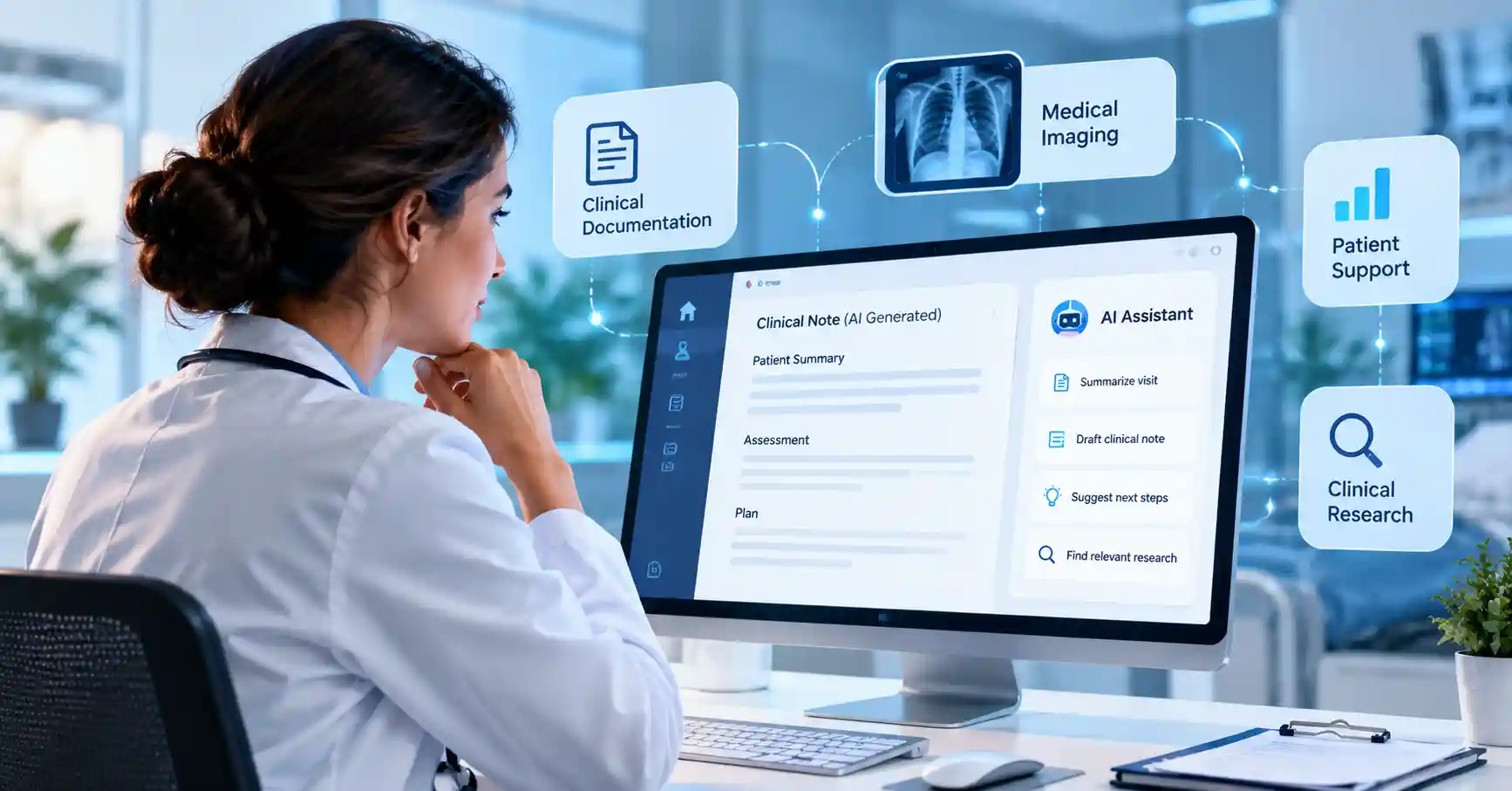
Healthcare professionals are turning to artificial intelligence (AI) to spend less time on documentation, organize medical information, streamline imaging workflows, and help patients make sense of their symptoms. The challenge is finding software that addresses a specific need without introducing unnecessary complexity or compromising clinical oversight.
Some of the best AI tools for healthcare focus on clinical documentation, including Microsoft Dragon Copilot, Abridge, and Heidi Health. Others, such as Aidoc, specialize in medical imaging, while Docus and Ada support different aspects of clinical assistance and patient health information.
This guide compares seven healthcare AI tools, covering their main features, intended users, pricing, and limitations. Whether you work in a hospital, manage a clinic, conduct healthcare research, or build health tech products, you'll find practical guidance for choosing software that fits your requirements.
What Are AI Tools for Healthcare?
AI tools for healthcare use technologies such as speech recognition, machine learning, and generative AI to assist with clinical and administrative work. Depending on the product, they can draft consultation notes, summarize patient conversations, analyze medical images, or provide preliminary information about symptoms.
Consider a doctor who needs to document several consultations during a busy clinic session. An AI medical scribe can generate a draft note from the conversation, allowing the doctor to focus more closely on the patient. Similarly, imaging AI can flag scans for urgent review so that clinical teams can prioritize their work.
These tools can support healthcare professionals, but their outputs still require appropriate review. AI generated notes can contain errors, and symptom assessments should not be treated as definitive diagnoses.
7 Best AI Tools for Healthcare Professionals
1. Microsoft Dragon Copilot : Best for Clinical Documentation
Official website: Microsoft Dragon Copilot
Microsoft Dragon Copilot is an AI clinical assistant designed to reduce documentation work and support healthcare workflows. It can capture patient conversations, generate specialty specific draft notes, and surface information from transcripts, existing notes, and medical references. Its supported workflows include integration with electronic health record (EHR) systems such as Epic.
Best for: Hospitals and clinicians looking for integrated documentation support.
Key benefit: Brings ambient documentation and clinical workflow assistance together.
Pricing: Contact Microsoft for commercial details.
Limitation: Availability varies by role and region. Check whether the product is available for your organization and location before planning a deployment.
Dragon Copilot is worth considering when documentation is a major workload and integration with existing healthcare systems is a priority.
2. Abridge : Best for Enterprise Healthcare Systems
Official website: Abridge clinical AI platform
Abridge converts clinical conversations into structured medical notes and connects the resulting documentation with clinical workflows. Its platform supports multiple specialties and care settings. Features such as linked evidence help clinicians review the source information behind AI generated notes.
Best for: Health systems that need documentation support across multiple departments.
Key benefit: Connects conversation capture, note generation, and EHR workflows.
Pricing: Public self service pricing was not verified request an enterprise quote.
Limitation: Implementation requirements and overall value depend on existing systems, governance policies, and deployment scope.
Abridge is a strong candidate for organizations evaluating documentation platforms at scale, rather than tools designed primarily for standalone transcription.
3. Heidi Health : Best for Individual Clinicians
Official website: Heidi Health pricing and plans
Heidi helps clinicians transcribe consultations, generate notes, and create structured documentation. It also offers Heidi Evidence, which provides citation backed answers to clinical questions.
Best for: Individual clinicians and smaller practices exploring AI assisted documentation.
Key benefit: The free plan includes unlimited transcription and standard template note generation.
Pricing: A free plan is available, while paid Clinician and Practice plans offer additional features. Check the official pricing page for current regional rates.
Limitation: Certain advanced features on the free plan are limited to 10 actions per month. Access to EHR integrations depends on the plan and supported partner.
For clinicians who want to try AI note taking before committing to a broader deployment, Heidi is a practical starting point.
4. Suki : Best for Voice Enabled Clinical Workflows
Official website: Suki AI assistant
Suki combines ambient documentation with voice enabled editing, clinical note generation, patient instructions, and other workflow assistance. Its official documentation describes integrations with Epic, Oracle Health, athenahealth, and MEDITECH.
Best for: Clinicians who want voice driven documentation connected to their EHR.
Key benefit: Supports documentation and related tasks within existing clinical workflows.
Pricing: Public pricing was not verified contact Suki for a quote.
Limitation: Available features depend on the integration and deployment configuration.
Suki deserves consideration when clinicians need more than a transcript and want to interact with documentation through voice commands.
5. Aidoc : Best for Medical Imaging Workflows
Official website: Aidoc clinical AI solutions
Aidoc develops clinical AI solutions that analyze medical imaging and help care teams prioritize findings, coordinate follow up, and manage patient workflows. Its platform covers areas including radiology, neurovascular care, cardiology, and vascular conditions.
Best for: Hospitals and radiology departments.
Key benefit: Helps teams identify potentially important findings and coordinate clinical responses.
Pricing: Contact Aidoc for deployment specific pricing.
Limitation: Aidoc is not a general purpose medical chatbot. Hospitals should verify the intended use, local authorization, compatibility, and supporting evidence for each specific algorithm.
If the main challenge involves imaging workflows rather than documentation, Aidoc is more relevant than a general purpose AI assistant.
6. Docus : Best for AI Assisted Health Information
Official website: Docus AI pricing
Docus offers separate products for patients, doctors, diagnostic laboratories, and healthcare businesses. Its doctor platform includes medical assistance, lab result interpretation, research assistance, and AI generated SOAP notes and reports.
Best for: Clinicians exploring AI supported documentation and lab result workflows, as well as consumers organizing health information.
Key benefit: Provides different features and plans for professional and personal use.
Pricing: The doctor platform lists a free plan for one patient. Paid plans are advertised at $25, $50, and $100 per month when billed annually. Patient plans have separate pricing and limits.
Limitation: AI generated interpretations are not definitive diagnoses. Clinicians should verify outputs, and users should review privacy and data handling terms before sharing sensitive information.
Healthcare organizations should evaluate Docus's doctor platform separately from its consumer facing offering because their intended users and usage limits differ.
7. Ada : Best for Patient Symptom Assessment
Official website: Ada symptom assessment
Ada provides a symptom assessment experience that asks users about their symptoms and health information before generating a report outlining possible explanations. The consumer facing tool is designed to help people understand their symptoms, not independently establish a diagnosis.
Best for: Individuals looking for preliminary symptom information and patient education.
Key benefit: Uses structured questions to guide users through a symptom assessment.
Pricing: Ada offers a free symptom assessment.
Limitation: The results may not account for every relevant clinical factor. Users should seek appropriate medical care, particularly when symptoms are severe or worsening.
Unlike the other tools in this comparison, Ada is primarily patient oriented rather than focused on professional documentation or hospital operations.
Healthcare AI Tools Compared
The right choice depends on the problem you need to solve, not simply the number of features a product offers.
Pricing reflects the information reviewed on October 15, 2026. Confirm current rates, regional availability, plan restrictions, and implementation costs directly with each provider before making a purchase decision.
How to Choose the Right Healthcare AI Software
Before adopting healthcare AI software, assess how well it fits the intended workflow and the requirements of your organization.
Define the problem first. Decide whether you need clinical documentation, imaging support, symptom assessment, or administrative assistance. This helps narrow the shortlist and avoid paying for unnecessary capabilities.
Check integration requirements. Confirm compatibility with your EHR, laboratory information system, imaging platform, and existing authentication processes. A tool that works independently may not fit smoothly into your current environment.
Review privacy and security. Understand how patient information is collected, stored, retained, and shared. Check contractual protections and applicable requirements, including HIPAA where relevant and India's Digital Personal Data Protection framework where applicable.
Evaluate clinical suitability. Examine supporting evidence, intended use, performance limitations, and any required regulatory authorization. The American Medical Association's AI Evaluation Guide recommends assessing clinical relevance, validation data, risk mitigation, performance, and workflow integration.
Run a controlled pilot. Test representative workflows using approved data. Measure factors such as note corrections, staff adoption, integration reliability, and total cost before expanding the deployment.
Healthcare AI should support qualified professionals, not transfer responsibility for clinical decisions to software. For diagnostic products, verify the authorization that applies to the specific product, intended use, and country. The US Food and Drug Administration's AI enabled medical devices resource explains its risk based approach to these technologies.
For more software options, explore the Allaipedia AI tools directory. If you're researching tools beyond healthcare, our guide to the best AI tools in 2026 provides a broader starting point.
FAQ’s
What are the best AI tools for healthcare professionals?
Dragon Copilot, Abridge, Heidi Health, and Suki are options for clinical documentation. Aidoc focuses on imaging workflows, while Docus supports clinical assistance and health information tasks. Ada is primarily designed for patient symptom assessment. The best option depends on your role, workflow, and technical requirements.
Are there free AI tools for healthcare?
Yes. Heidi offers a free plan with unlimited standard template notes and transcription, subject to restrictions on advanced features. Docus has separate free plans for doctors and patients, while Ada offers a free symptom assessment. However, free access does not automatically mean a product is suitable for storing identifiable patient information.
Can AI tools diagnose medical conditions?
Some specialized medical AI systems are authorized for specific diagnostic or decision support purposes. General purpose chatbots and consumer symptom checkers should not be treated as definitive diagnostic services. Clinical decisions require appropriate professional judgment and review.
Are healthcare AI tools safe for patient data?
Safety depends on the product, its configuration, the data involved, and the applicable legal requirements. Before uploading patient information, verify the provider's data handling terms, security controls, retention policies, contractual protections, and authorization for your intended use.
Conclusion
The best AI tools for healthcare address specific needs rather than attempting to automate every aspect of medical practice. Heidi is worth exploring for accessible clinical documentation, while Dragon Copilot, Abridge, and Suki are candidates for more integrated clinical workflows. Aidoc focuses on imaging, whereas Docus and Ada serve different clinical assistance and patient information needs.
Before committing, check regional availability, integrations, pricing, and clinical suitability. Start with a controlled pilot and require human review wherever patient care or clinical records are involved. A tool that fits your workflow and meets your safety requirements is a better investment than one chosen solely for its feature list.