Best AI Tools for HR and Recruitment in 2026: Top Picks Compared
Published October 15, 2026
Hiring the right people takes time. Recruiters often juggle hundreds of applications, arrange interviews, and keep candidates updated throughout the process. The best AI tools for HR and recruitment can take some of that administrative work off their hands, making it easier to focus on evaluating candidates and building relationships.
But not every business needs a full scale recruitment platform. Some teams struggle to find qualified candidates, while others need help screening resumes, coordinating interviews, or managing the entire hiring process.
This guide compares five recruitment platforms, looks at their strengths and limitations, and explains which options make sense for different hiring needs.
Table of Contents
What Are AI Tools for HR and Recruitment?
Best AI Tools for HR and Recruitment Compared
How to Choose the Right AI Recruiting Software
How to Use AI in a Recruitment Workflow
Benefits and Limitations of AI in Recruitment
Frequently Asked Questions
Conclusion
What Are AI Tools for HR and Recruitment?
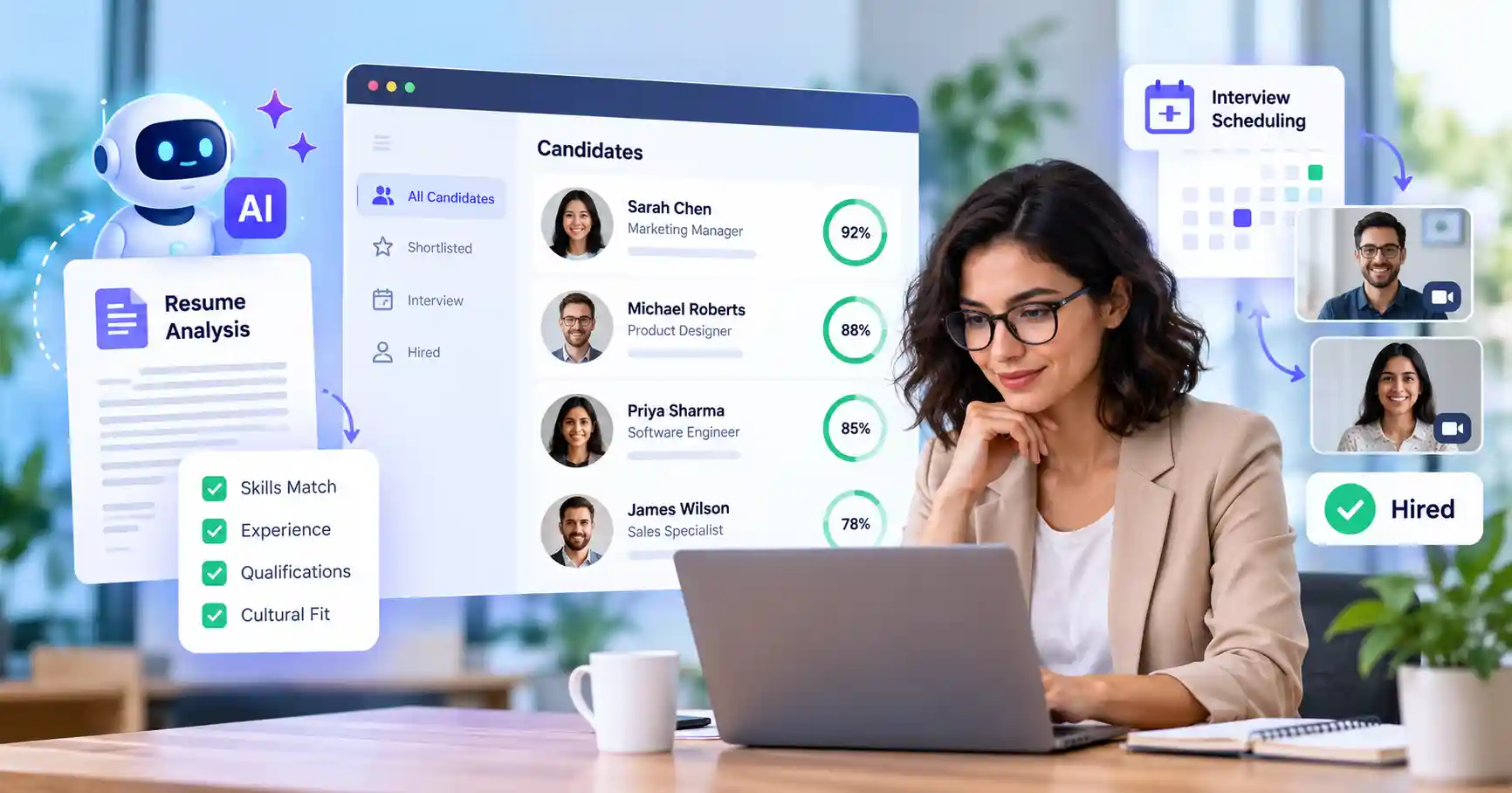
AI recruiting tools help HR teams handle tasks such as drafting job descriptions, finding potential candidates, reviewing applications, scheduling interviews, and summarizing interview feedback.
These capabilities may be built into an applicant tracking system (ATS) or provided through a dedicated recruitment platform.
Consider a growing company hiring a software developer. Its recruiter could use AI to draft the job description, organize applications, and prepare structured interview questions. The recruiter would still need to verify candidates' qualifications and make the final hiring decision.
The real value lies in reducing repetitive work without losing sight of what matters: finding the right people through a fair, transparent, and human led process.
Best AI Tools for HR and Recruitment Compared
Each platform below addresses a different part of the recruitment process. The recommendations reflect documented product capabilities and suitability for specific workflows they are not based on claimed hands on testing.
For an integrated recruitment and HR system, consider Workable. LinkedIn Recruiter is worth exploring when sourcing is the main challenge, while HireVue focuses on interviews and assessments. Greenhouse supports structured hiring, and Paradox is geared toward conversational candidate engagement.
1. Workable: Best for Integrated Recruitment and HR
Workable brings together applicant tracking, candidate sourcing, interview scheduling, and HR management. Its Workable Agent supports early stage recruitment tasks, including sourcing, screening, and candidate qualification.
This makes it worth considering for small and medium sized businesses that want to manage recruitment without piecing together several separate systems.
Pricing: Workable's published Standard plan starts at $299 per month for organizations with 1–20 employees. Its website also lists a 15 day trial without requiring a credit card. Workable Agent uses AI credits, and each paid account includes 3,000 credits to try the agent.
Limitations: AI credits can add to the cost as hiring activity increases. Before committing, estimate how frequently your team will use these features and whether additional credits may be necessary.
Workable is a strong candidate for teams that want recruitment, onboarding, employee records, and related HR workflows in one place. See the official Workable pricing page for current terms.
2. LinkedIn Recruiter: Best for Candidate Sourcing
LinkedIn Recruiter helps recruiters find professionals, identify potential matches, and reach people who may not be actively applying for jobs.
Its AI supported capabilities can assist with candidate discovery and personalized outreach. This is particularly useful when hiring for specialist positions where suitable candidates may be difficult to reach through job advertisements alone.
Pricing: LinkedIn does not publish one standard price for Recruiter. Costs depend on the selected offering, contract, team requirements, and other factors.
Limitations: Finding candidates is only one part of hiring. You may still need a separate ATS, assessment platform, or interview management system. Results also depend on whether LinkedIn has suitable profiles for the roles you're filling.
Recruitment agencies, in house talent acquisition teams, and businesses hiring for specialized positions are the most natural fit.
3. HireVue: Best for Interviews and Assessments
HireVue specializes in digital interviewing and hiring assessments. Its AI Interviewer product supports structured candidate conversations, helping employers gather relevant information earlier in the recruitment process.
For instance, a company hiring customer support representatives at scale could use structured initial interviews to collect consistent responses before arranging conversations with hiring managers.
Pricing: HireVue directs prospective customers toward demos and tailored sales discussions rather than publishing one standard price.
Limitations: Automated interviews and assessments require careful oversight. Recruiters should understand how candidates are evaluated, provide appropriate accommodations, and ensure the process measures skills relevant to the role. AI generated evaluations should inform decisions, not determine them without human review.
HireVue is best suited to larger organizations that need repeatable interviews and assessments across multiple roles.
4. Greenhouse: Best for Structured Hiring
Greenhouse combines applicant tracking with AI supported recruitment workflows. Its documented capabilities include interview transcription and notes, resume review, structured hiring plans, candidate rediscovery, and reporting assistance.
One useful feature is its Notetaker, which records and transcribes interviews and maps AI generated notes to scorecard questions. This can help interviewers stay focused on the conversation rather than constantly taking notes.
Pricing: Greenhouse directs prospective buyers toward a demo. Check which AI features are included in your subscription tier and whether any require higher tier access.
Limitations: Greenhouse makes more sense for organizations with defined hiring stages and multiple interviewers than for businesses looking for a standalone AI writing tool. Its outputs are also more useful when teams agree on interview questions and evaluation criteria.
It's worth considering if your company wants a more consistent hiring process across departments.
5. Paradox: Best for Conversational Recruitment
Paradox focuses on conversational recruiting, helping candidates interact with employers and move through hiring workflows with less manual coordination.
Imagine a retailer recruiting staff across several locations. Conversational recruitment could help manage candidate engagement and interview scheduling, reducing the need for recruiters to coordinate every interaction manually.
Pricing: A standard public price was not verified for this comparison. Contact the vendor to confirm current packages, availability, and costs.
Limitations: Conversational automation is most useful when hiring follows a repeatable, high volume process. A small company recruiting only a few specialist roles each year may see less value. Check available integrations and scheduling capabilities before making a decision.
Paradox is worth evaluating when candidate communication and interview coordination consume a significant amount of a hiring team's time.
How to Choose the Right AI Recruiting Software
The right AI recruiting software depends on your hiring volume, existing systems, and the specific problem you want to solve.
Match the tool to your hiring needs
Small businesses: Consider Workable if you need applicant tracking and HR management in one platform. Check whether the subscription and AI credit costs fit your budget.
Recruitment agencies: Look at LinkedIn Recruiter if finding and engaging qualified candidates is your biggest challenge.
Enterprise HR teams: Evaluate Greenhouse or HireVue when structured interviews, consistent assessments, and reporting matter most.
High volume employers: Consider Paradox if candidate communication and interview scheduling create substantial administrative work.
Look beyond the starting price
Before purchasing, confirm that the platform integrates with your calendar, existing ATS, HR information system, and other essential software. Check the details for your specific subscription rather than assuming every integration is included. Explore Allaipedia's AI tools directory
Privacy and security deserve the same attention. Review data retention policies, access controls, security documentation, and how candidate information is processed. A low starting price may not reflect the full cost of extra seats, assessments, AI credits, or integrations.
How to Use AI in a Practical Recruitment Workflow
Consider a small business hiring a marketing manager. Rather than automating the entire process, the recruiter can introduce AI at specific stages.
Draft the job description. Use AI to organize responsibilities, role requirements, and essential qualifications. Review the draft and remove vague or unrealistic expectations.
Organize applications. Use an ATS to collect resumes and maintain candidate records. AI assisted screening can help identify relevant experience against predefined job criteria.
Prepare interviews. Generate questions linked to the role's actual requirements. Keep the core questions and scorecard consistent across candidates applying for the same position.
Coordinate interviews. Use scheduling automation to reduce back and forth communication and keep candidates informed.
Make the hiring decision. Review resumes, interviews, assessments, and references where appropriate. Recruiters and hiring managers should remain accountable for the outcome.
For a related perspective on the candidate side of hiring, explore Allaipedia's guide to AI resume builders. Resume builders help job seekers prepare applications, whereas recruitment platforms help employers manage the hiring process.
Benefits and Limitations of AI in Recruitment
AI can cut down on repetitive administration, help recruiters organize large applicant pools, and support more consistent interviews. It can also make candidate communication easier to manage and summarize information that would otherwise require manual effort.
But faster processing doesn't necessarily lead to better hiring.
AI systems can overlook qualified candidates, reproduce patterns found in historical data, or generate inaccurate summaries. Screening tools may also favor familiar keywords while missing relevant experience described in different terms.
To reduce these risks, recruiters should define job related criteria before screening applications, review borderline cases, and periodically check outcomes for potential bias. Candidates should receive appropriate information about automated assessments, and employers should provide reasonable accommodations where required.
The Greenhouse AI principles offer a useful starting point for evaluating transparency and human oversight. Employers should also review the employment, privacy, and discrimination laws that apply in the regions where they hire.
FAQ’s
What is the best AI tool for recruitment?
There isn't one tool that suits every employer. Workable is worth considering for integrated recruitment and HR workflows, LinkedIn Recruiter for candidate sourcing, HireVue for interviews and assessments, Greenhouse for structured hiring, and Paradox for conversational recruitment.
Are there free AI recruiting tools?
Some platforms offer free trials or limited access to specific features, but availability varies. Workable lists a 15 day trial without requiring a credit card, although Workable Agent access is excluded from the trial. Check the current terms before signing up.
Can AI automatically screen resumes?
Yes. Some recruitment platforms offer AI assisted resume review or screening against specified criteria. However, results can be incomplete or biased. Review the supporting evidence, validate the criteria, and don't treat an automated ranking as the final hiring decision.
Can AI replace recruiters?
AI can assist with repetitive tasks such as scheduling, sourcing, and summarizing interview notes. It cannot reliably replace the full responsibilities of a recruiter, including understanding business needs, building candidate relationships, evaluating context, and taking responsibility for hiring decisions.
Conclusion
The best AI tools for HR and recruitment solve a specific hiring problem without introducing unnecessary cost or risk.
Start by identifying your biggest bottleneck. Choose Workable for integrated workflows, LinkedIn Recruiter for sourcing, HireVue for structured assessments, Greenhouse for hiring consistency, or Paradox for conversational recruitment. Then check pricing, integrations, data protection, and the features included in your chosen plan.
Before rolling out a platform across your organization, test it against a real recruitment workflow and assess whether it improves the process. AI should help your team make better informed decisions, with human judgment remaining central to every hire.